Deokhongjeon Hall, Deoksugung Palace. Photo: Royal Palaces and Tombs Center, used under KOGL Type 1.
Deoksugung Palace: Where Joseon Meets the Korean Empire
Of Seoul’s five royal palaces, Deoksugung Palace may be the one where Korea’s transition into the modern era is most visible.
Traditional palace halls stand alongside Western-style stone buildings, creating a striking contrast that reflects a turbulent period in Korean history. Deoksugung’s story stretches from the Joseon Dynasty through the Japanese invasions of the late 16th century and into the Korean Empire, when Emperor Gojong made the palace the center of a newly proclaimed imperial Korea.
Unlike many royal palaces, Deoksugung was not originally built as a palace at all. The site began as the private residence of Grand Prince Wolsan, the older brother of King Seongjong. Its role changed dramatically after the Japanese invasions of Korea began in 1592 and Seoul’s royal palaces were destroyed. When King Seonjo returned to the capital, the residence became a temporary royal palace in 1593.
In 1611, during the reign of King Gwanghaegun, the complex was officially named Gyeongungung Palace. After Changdeokgung was rebuilt, however, Gyeongungung became a secondary palace and remained relatively quiet for much of the following centuries.
Its importance returned dramatically in the late 19th century.
King Gojong moved back to Gyeongungung during a period of enormous political upheaval and, in 1897, proclaimed the Korean Empire, taking the title of emperor. The palace became an imperial residence and an important center of government during Korea’s efforts to assert its independence and modernize in the face of increasing foreign pressure.
In 1907, Emperor Gojong was forced to abdicate the throne under pressure from the Japanese Empire, and his son Sunjong succeeded him. Gojong remained at Gyeongungung, while Sunjong moved to Changdeokgung. At that time, Gyeongungung was renamed Deoksugung, meaning “Palace of Virtuous Longevity,” a name intended to express the hope that the retired emperor would enjoy a long life.
That layered history is still visible throughout Deoksugung today. Traditional structures such as Junghwajeon, the palace’s main throne hall, stand alongside Western-influenced buildings including Jeonggwanheon and the grand neoclassical Seokjojeon. Together, they reflect Deoksugung’s unusual journey from a Joseon royal residence to the imperial palace of Gojong and, later, the home of a retired emperor. More than any of Seoul’s other royal palaces, Deoksugung captures a period when centuries of Korean royal tradition were colliding with political upheaval, foreign influence, and the pressures of a rapidly changing modern world.
What to See at Deoksugung Palace
Daehanmun Gate
Today, visitors enter Deoksugung through Daehanmun, the palace’s main gate. It was not originally the primary entrance. As Seoul’s city center shifted toward the eastern side of the palace, this gate became more important and eventually took over as the main entrance. After being damaged in the major palace fire of 1904, it was repaired and renamed Daehanmun.
Daehanmun is also the setting for Deoksugung’s popular Royal Guard Changing Ceremony, where guards in colorful traditional uniforms recreate the changing of the palace guard accompanied by traditional music.
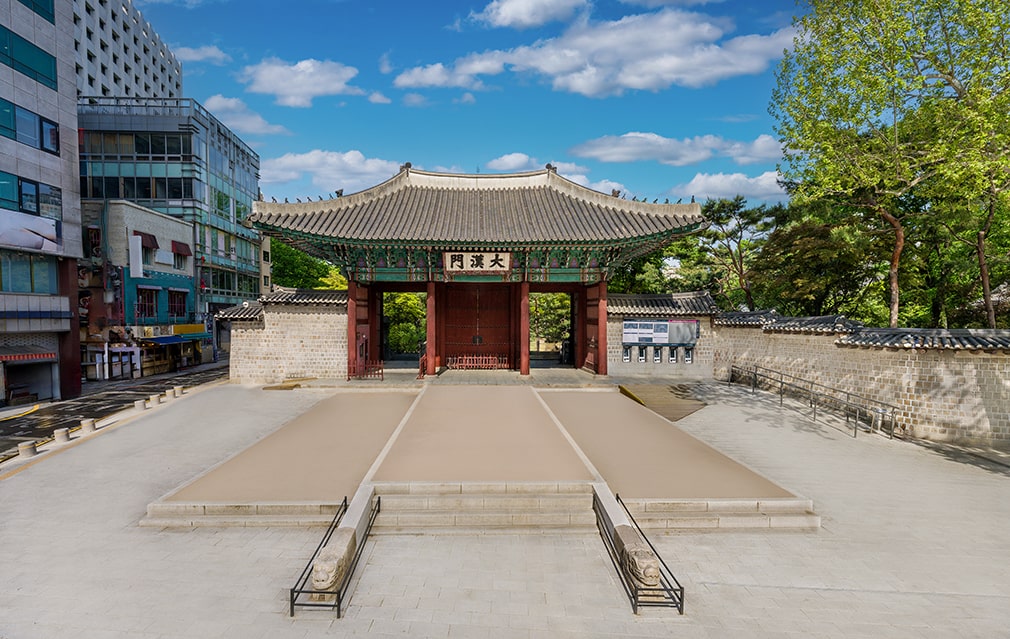
Daehanmun Gate, Deoksugung Palace, full view. Photo: Royal Palaces and Tombs Center, used under KOGL Type 1.
Junghwajeon Hall
Passing through Junghwamun Gate leads to Junghwajeon, Deoksugung’s main throne hall and one of the palace’s most important traditional structures.
Junghwajeon served as the ceremonial center of the palace during the Korean Empire, where Emperor Gojong conducted official affairs and received important guests. Like the throne halls at Seoul’s other royal palaces, its interior centers on the royal throne and the colorful Irworobongdo, the traditional painting of the sun, moon, and five peaks displayed behind it.
Although unmistakably traditional in design, Junghwajeon belongs to a very different chapter of Korean history than the throne halls at Gyeongbokgung or Changdeokgung. Here, the traditional architecture of the Joseon court became part of the new imperial palace of the Korean Empire, and that shift can be seen in the details of the hall itself. The unique design is highlighted by the two dragons carved into the steps leading up to Junghwajeon Hall. Earlier Joseon throne halls traditionally featured phoenixes, but because Junghwajeon was built after the declaration of the Korean Empire, dragons were used instead to symbolize the dignity and authority of the emperor.
Numerous stone rank markers also line both sides of the walkway leading to the hall. Each marker indicates where government officials stood according to their rank during official ceremonies. The corridors that once ran along both sides of the gates have largely been lost, with only a portion of the eastern corridor remaining today.
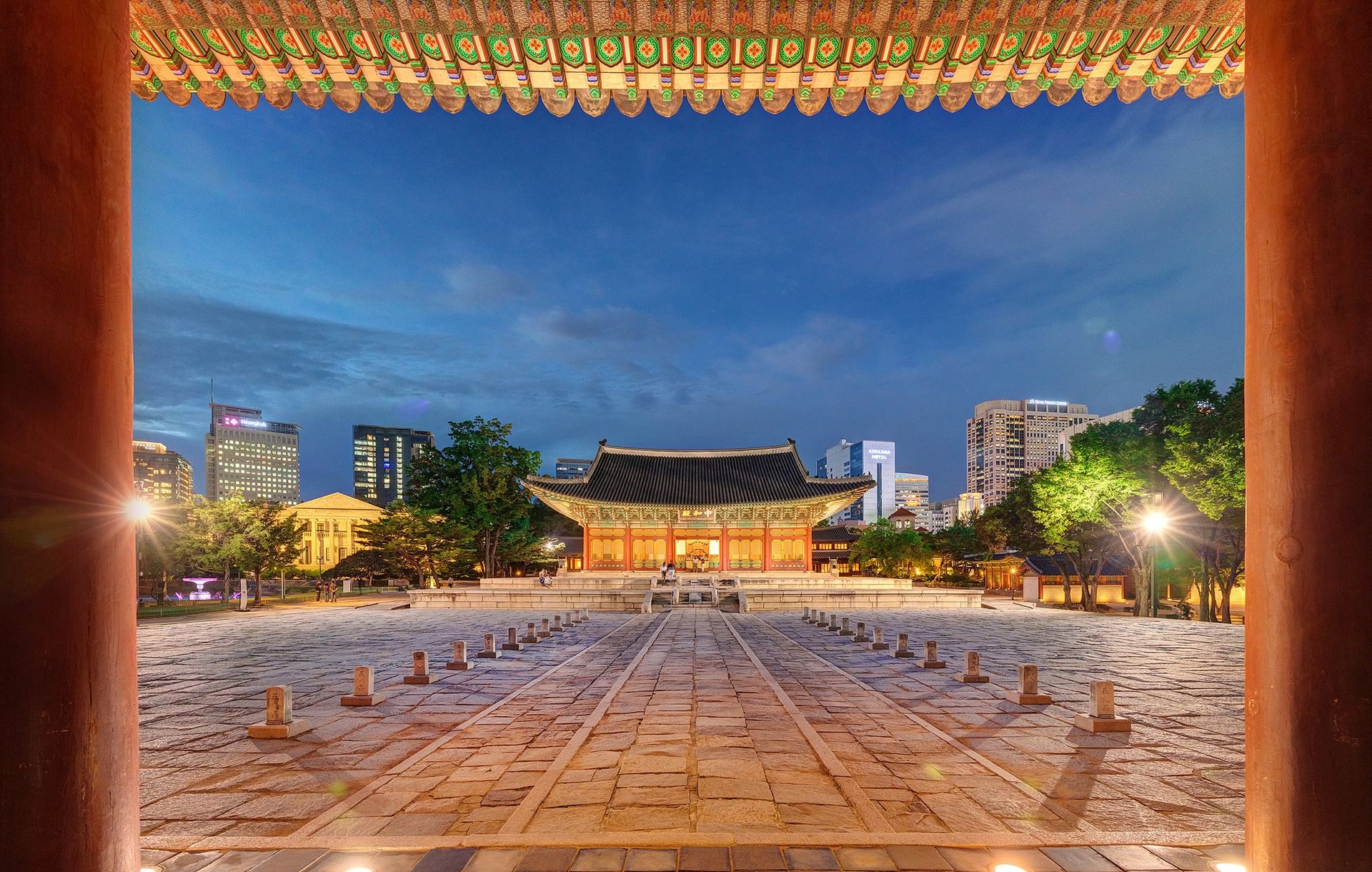
Night view of Junghwajeon Hall, Deoksugung Palace. Photo: Royal Palaces and Tombs Center, used under KOGL Type 1.
Jeonggwanheon Pavilion
That combination makes Jeonggwanheon an especially fitting transition between the traditional royal architecture of Junghwajeon and the fully Western-style Seokjojeon nearby.
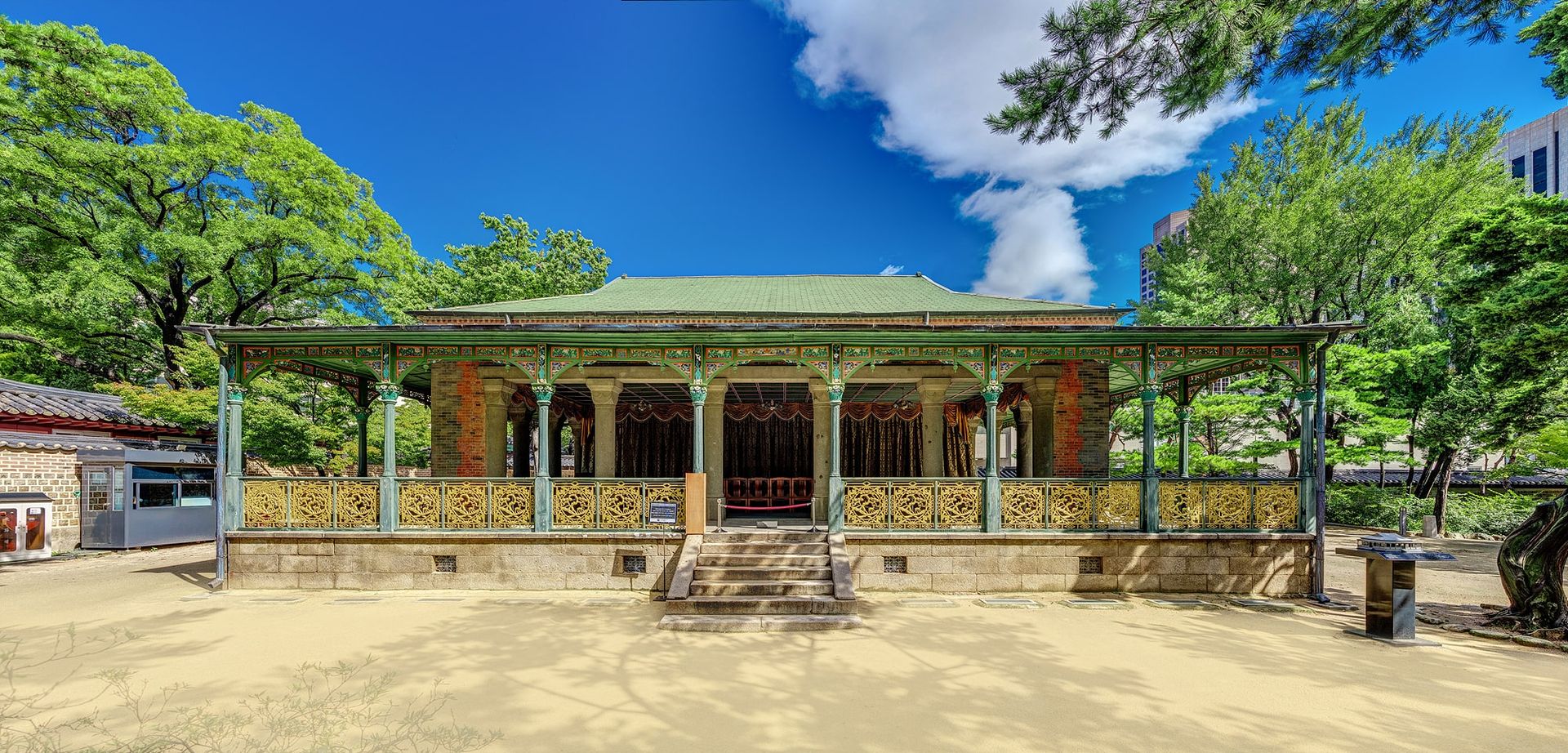
Jeonggwanheon Pavilion, Deoksugung Palace. Photo: Royal Palaces and Tombs Center, used under KOGL Type 1.
Seokjojeon Hall
Today, the restored Seokjojeon houses the Daehan Empire History Museum, where period rooms, furnishings, and exhibits give visitors a closer look at the imperial court and at Emperor Gojong’s efforts to navigate one of the most turbulent periods in modern Korean history.
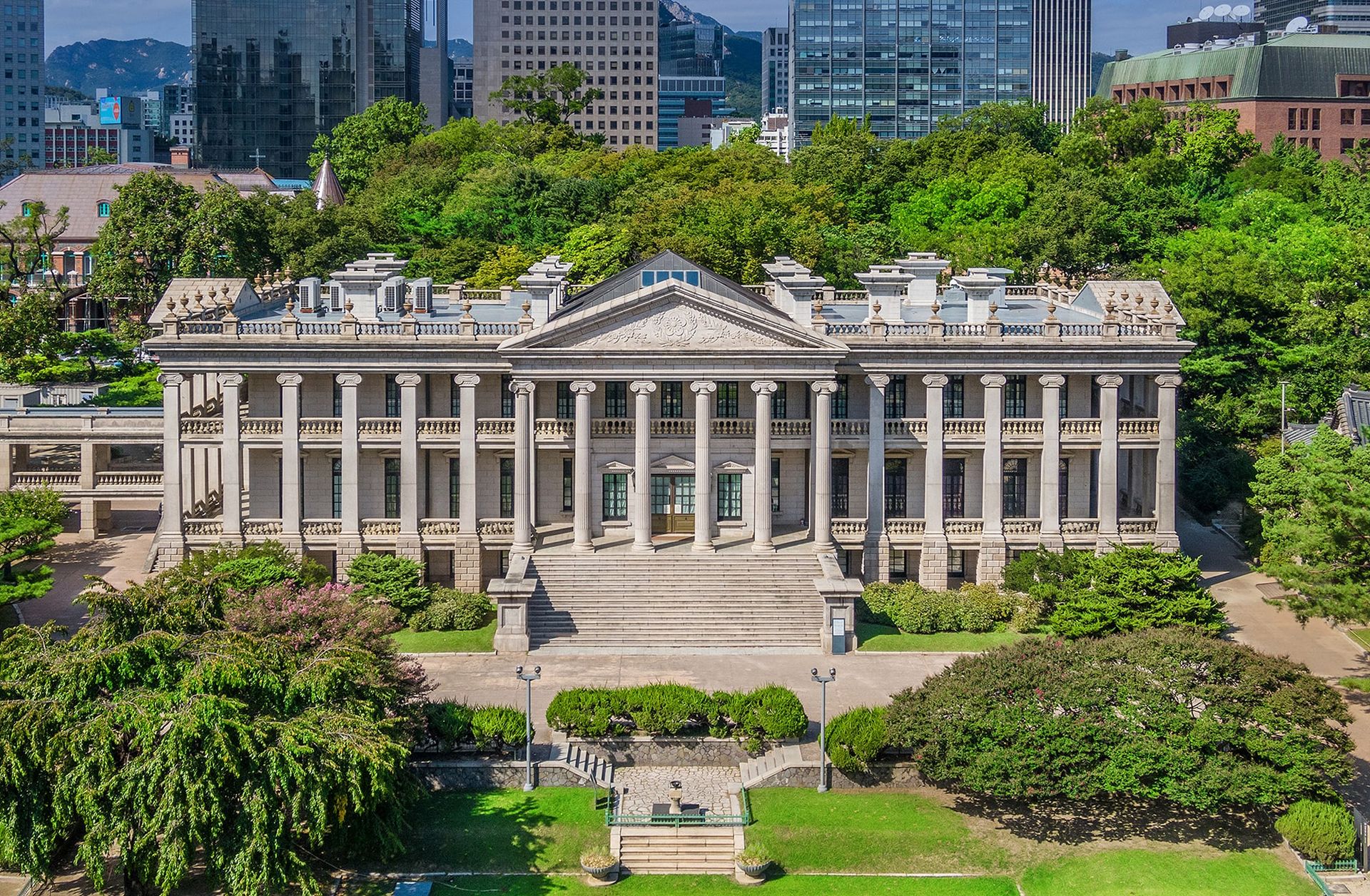
Full view of Seokjojeon Hall, Deoksugung Palace. Photo: Royal Palaces and Tombs Center, used under KOGL Type 1.
Deoksugung has many other historic buildings and structures worth exploring, including royal residences, ceremonial halls, and restored buildings from the Korean Empire period. The sites highlighted here are just some of the palace’s most distinctive stops, particularly those that best illustrate Deoksugung’s transition from a traditional Joseon palace to the center of the Korean Empire.
Planning Your Visit to Deoksugung Palace
Where is Deoksugung Palace?
Deoksugung is located at 99 Sejong-daero in Jung-gu, Seoul, directly across from Seoul City Hall. Its central location makes it one of the easiest of Seoul’s royal palaces to incorporate into a day of sightseeing.
How do I get there?
Take Seoul Subway Line 1 or Line 2 to City Hall Station. The palace is only a short walk from the station, with Daehanmun Gate located near Exit 1.
When is Deoksugung open?
Deoksugung is generally open from 9:00 a.m. to 9:00 p.m., with last admission at 8:00 p.m. The palace is typically closed on Mondays. If Monday falls on a public holiday, it may open that day and close the following business day instead.
Because schedules, holiday closures, exhibitions and special programs can change, check the official Korea Heritage Service Royal Palaces and Tombs Center website before visiting.
How much time should I allow?
Allow approximately one and a half to two hours to explore the main palace grounds and buildings.
Plan additional time if you want to visit the Daehan Empire History Museum inside Seokjojeon, explore the nearby Deoksugung Stone Wall Path, or spend time at the National Museum of Modern and Contemporary Art located within the palace grounds.
Can I visit Seokjojeon Hall?
Yes, but access to the interior of Seokjojeon is more limited than general palace admission. The Daehan Empire History Museum operates on its own schedule, and some interior tours require advance online reservations and are conducted with a guide.
If seeing the restored imperial rooms is important to you, check current reservation requirements before your visit.
Is Deoksugung open at night?
Yes. Deoksugung is regularly open into the evening, making it one of the easiest royal palaces to experience after sunset. The palace grounds remain open until 9:00 p.m., with last admission at 8:00 p.m.
The traditional palace buildings and Western-style structures take on a very different atmosphere when illuminated at night.
Can I see the Royal Guard Changing Ceremony?
The Royal Guard Changing Ceremony takes place outside Daehanmun Gate and recreates the traditional changing of the palace guard with period costumes, music and ceremonial procedures.
Schedules can change because of weather, special events and seasonal programming, so check the current ceremony schedule before planning your visit.
Is admission free if I wear hanbok?
Visitors wearing qualifying traditional or modernized hanbok may receive free general palace admission.
The outfit must include both an appropriate upper garment and lower garment. Simply wearing a traditional-style outer garment does not meet the official requirements.
There are many hanbok rental shops throughout central Seoul, although fewer are concentrated immediately around Deoksugung than around Gyeongbokgung.
What else is nearby?
One of Deoksugung’s best-known neighboring attractions is the Deoksugung Stone Wall Path, a picturesque pedestrian walkway that follows the palace wall through the Jeong-dong area.
The palace is also within easy reach of Seoul City Hall, Seoul Plaza and several museums and historic sites, making it particularly easy to combine with other stops in central Seoul.
Where can I find current visitor information?
The best source is the official Korea Heritage Service Royal Palaces and Tombs Center website, which provides current opening hours, admission information, closures, reservations and visitor notices.
Seoul’s official tourism site, VisitSeoul.net, and the Korea Tourism Organization’s VisitKorea site also provide directions and general visitor information.
Seoul's Five Grand Palaces Series
Explore all five of Seoul's historic royal palaces:
👇 Join the newsletter so you don’t miss any updates!
Keep Watching, Keep Feeling
Thanks for reading. 💖
If you enjoy thoughtful K-drama recommendations, reviews, and hidden details, explore more here on Korean Drama Insider.
🎬 Want more? Check out our other articles and watch lists for more heartfelt, spoiler-free K-drama reviews and recommendations, straight from one drama fan to another.